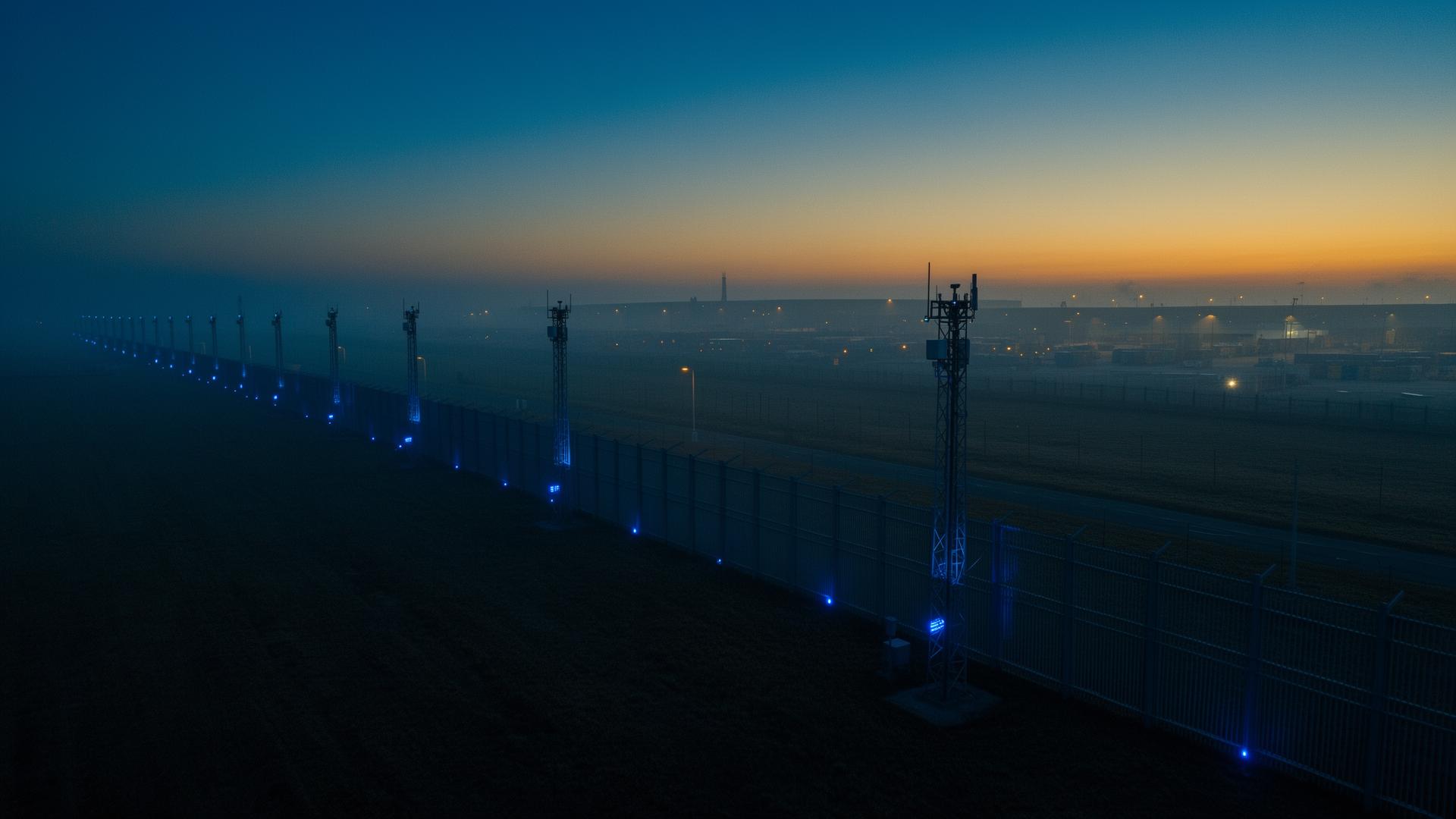
Perimeter Protection for Critical Environments
Multi-layer detection engineered for kilometres of demanding terrain.
Common Challenges
High false-alarm rates
Operators desensitised by nuisance triggers — the worst possible failure mode.
Coverage gaps in long perimeters
Single-sensor solutions can't span kilometres of varied terrain reliably.
Difficult terrain & weather
Monsoon, fog and heat-haze defeat any single sensing technology.
Slow human verification loops
Minutes between detection and verified response — too slow for real intrusion.
Disconnected fence, CCTV and guard ops
Three separate workflows running in parallel instead of one integrated SOP.
How Arif Khan Approaches It
Sensor fusion — radar, fibre, thermal, video analytics — orchestrated by a single command layer with SOP-driven response protocols.
Understand Environment
Deep discovery: site, threat model, operational reality, owner intent.
Design Architecture
Vendor-neutral systems architecture aligned to outcomes — not catalogues.
Integrate Systems
Engineer the program as one fabric, not a stack of independent products.
Validate Performance
Measure, calibrate, prove. Nothing is signed off until it performs.
Optimize Experience
Refine the human and operator experience over the long lifecycle.
Technology Components
Fibre Intrusion Detection
Continuous detection along the entire boundary, immune to weather.
Ground & Drone Radar
Wide-area detection beyond the fence line with low false-alarm rates.
Thermal Imaging
All-weather verification at long range, day and night.
AI Video Analytics
Classification, behaviour analysis and event correlation.
Command & Control
Single workflow unifying every sensor and the field response.
Response SOPs
Documented protocols binding guard force, technology and management.
Where It Gets Applied
Common Mistakes
Single-sensor procurement instead of fusion design
No SOP for verified response
Ignoring terrain and weather at design stage
Treating perimeter as a fence, not a system
The terms you'll hear, explained
Specifications and proposals across security, automation and AV reuse the same vocabulary. Here are the ones that matter most — without the jargon.
A separate logical network on shared cabling — cameras, access control and BMS each get their own VLAN so traffic stays isolated and easier to secure.
Permissions are granted to roles (operator, supervisor, FM head) rather than individual users — clean, auditable, easier to revoke.
Automatic Number-Plate Recognition — reads vehicle plates at gates and barriers for whitelists, visitors and incident lookup.
An open standard that lets cameras and recorders from different brands talk to each other — protects you from single-vendor lock-in.
Open protocols used by BMS, HVAC and energy systems to exchange data — the building's nervous system.
One cable carries data and power to a camera, access reader or AP — simpler installation, fewer points of failure.
BMS runs HVAC and electrical. IBMS integrates BMS with security, fire, access, AV and energy under one operating model.
Public Address / Voice Alarm — code-compliant intelligible voice evacuation, required for crowded venues and large buildings.
Modern video compression — typically 40–60% less storage than H.264 at the same forensic quality.
Mean Time Between Failures — the right metric for picking industrial gates, barriers and infrastructure-grade equipment.
Storage redundancy — protects recordings against single-disk failure. Plan capacity after RAID overhead, not before.
Service Level Agreement — written response and resolution times that an AMC must meet. Vague SLAs aren't SLAs.
Frequently Asked Questions
How long can a perimeter program span?+
Programs led by Arif Khan have cumulatively secured 500km+ of perimeter, including individual sites running into tens of kilometres.
Can existing fence be reused?+
Often yes — fibre intrusion detection and analytics retrofit onto existing fencing, reducing capex meaningfully.
Which sensor technologies are used?+
Fibre PIDS, ground radar, thermal cameras, microwave, taut-wire and AI video analytics — combined per terrain, threat and budget.
How are false alarms controlled?+
Through sensor fusion, AI classification, scheduled tuning windows and an event-correlation engine in the command layer.
Is the system Indian-regulation compliant?+
Yes — designs respect MHA, MoD, CISF and sector-specific perimeter guidelines, and use approved OEMs where mandated.
Do you provide ongoing monitoring?+
Yes — optional 24×7 monitoring with SLA-bound response coordination with on-site guard forces.
What is the typical false-alarm rate target?+
Sub-5% across the integrated stack after tuning, validated against weeks of live operation.
How do you handle expansions and new sites?+
Reference designs allow rapid replication across new sites without redesigning from zero.


For project-level planning across India, see Arif Khan's related consulting expertise:
Let's Design Intelligent Environments
A private consultation to scope your environment, the threats it faces, and the architecture that will serve it for the next decade.
Arif Khan supports project planning and advisory requirements across Delhi NCR — including Delhi, New Delhi, Gurugram, Gurgaon, Faridabad, Ghaziabad and Meerut — along with selected projects in Mumbai, Lucknow, Bengaluru and North India.