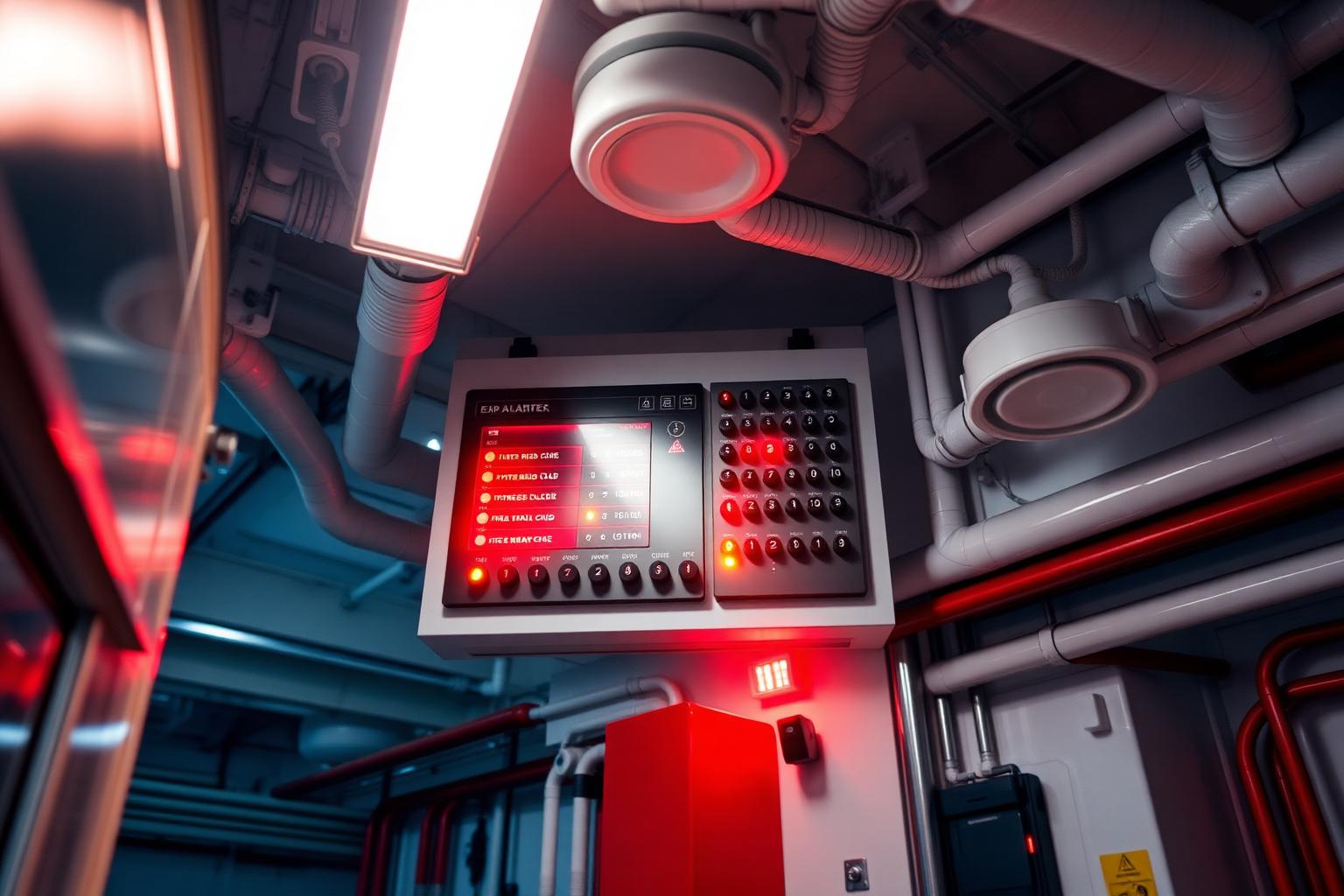
Fire Alarm & Life Safety Systems
Addressable detection, voice evacuation and code-compliant life safety — engineered for Indian regulation and global insurance standards.
Common Challenges
Conventional panels in addressable buildings
Zone-level granularity in buildings that need device-level identification.
Voice evacuation missing or unintelligible
Alarm bells where voice messaging is mandated; STI scores that fail when tested.
No integration with BMS, access or HVAC
Smoke not exhausted, doors not released, lifts not recalled on alarm.
Fragile commissioning and testing
Systems handed over without device-by-device cause-and-effect validation.
Code drift between design, install and inspection
Drawings, panel and reality diverging — a regulatory and insurance risk.
Aging panels with no spares
End-of-life systems running on borrowed time.
How Arif Khan Approaches It
Design to NBC 2016, NFPA 72 / 101 and local Fire NOC requirements. Specify addressable detection with voice evacuation, integrate cause-and-effect across HVAC, access, lifts and BMS, and validate the program device by device — using OEMs accepted by the local Chief Fire Officer and global insurance underwriters.
Understand Environment
Deep discovery: site, threat model, operational reality, owner intent.
Design Architecture
Vendor-neutral systems architecture aligned to outcomes — not catalogues.
Integrate Systems
Engineer the program as one fabric, not a stack of independent products.
Validate Performance
Measure, calibrate, prove. Nothing is signed off until it performs.
Optimize Experience
Refine the human and operator experience over the long lifecycle.
Technology Components
Addressable Fire Panels
Honeywell, Notifier, Siemens, Edwards, Bosch, Ravel, Agni — code-listed.
Smoke, Heat & Multi-Sensor Detection
Device-level identification across every space.
Voice Evacuation (PAVA)
EN 54-16 / -24 PAVA with intelligibility validated by STI test.
Suppression Integration
FM-200, NOVEC, water mist and sprinkler interfacing.
Cause-and-Effect with BMS
Smoke control, door release, lift recall, HVAC shutdown.
Graphics & Command
Mimic / graphics workstation for the fire command centre.
Where It Gets Applied
Common Mistakes
Conventional panels in addressable buildings
Skipping STI validation for voice evacuation
No cause-and-effect testing with BMS / HVAC / lifts
Choosing OEMs not accepted by the local Fire NOC
Treating annual maintenance as a tick-box instead of a regime
The terms you'll hear, explained
Specifications and proposals across security, automation and AV reuse the same vocabulary. Here are the ones that matter most — without the jargon.
A separate logical network on shared cabling — cameras, access control and BMS each get their own VLAN so traffic stays isolated and easier to secure.
Permissions are granted to roles (operator, supervisor, FM head) rather than individual users — clean, auditable, easier to revoke.
Automatic Number-Plate Recognition — reads vehicle plates at gates and barriers for whitelists, visitors and incident lookup.
An open standard that lets cameras and recorders from different brands talk to each other — protects you from single-vendor lock-in.
Open protocols used by BMS, HVAC and energy systems to exchange data — the building's nervous system.
One cable carries data and power to a camera, access reader or AP — simpler installation, fewer points of failure.
BMS runs HVAC and electrical. IBMS integrates BMS with security, fire, access, AV and energy under one operating model.
Public Address / Voice Alarm — code-compliant intelligible voice evacuation, required for crowded venues and large buildings.
Modern video compression — typically 40–60% less storage than H.264 at the same forensic quality.
Mean Time Between Failures — the right metric for picking industrial gates, barriers and infrastructure-grade equipment.
Storage redundancy — protects recordings against single-disk failure. Plan capacity after RAID overhead, not before.
Service Level Agreement — written response and resolution times that an AMC must meet. Vague SLAs aren't SLAs.
Frequently Asked Questions
Which standards do you design to?+
NBC 2016 (India), NFPA 72 and NFPA 101, local State Fire Service requirements and the building's insurance underwriter standards.
Which fire alarm brands do you specify?+
Honeywell, Notifier, Siemens Cerberus, Edwards / EST, Bosch, Ravel and Agni — selected against Fire NOC acceptance, scale and lifecycle.
Do you handle Fire NOC documentation?+
Yes — drawings, calculations and submission packs prepared for the Chief Fire Officer and local fire department.
Is voice evacuation always required?+
Required for high-rises, malls, hospitals, hotels and large assembly buildings under NBC. We specify EN 54-16 / -24 PAVA with STI validation.
Do you integrate fire with BMS, access and lifts?+
Yes — cause-and-effect across smoke control, door release, lift recall and HVAC shutdown is part of every program.
Do you handle gas suppression for data centres?+
Yes — FM-200, NOVEC 1230 and water-mist systems integrated with detection and BMS.
What ongoing maintenance is required?+
Quarterly device testing, annual panel validation and a documented retest after any building modification.
Where have you delivered life-safety programs?+
Corporate towers, hospitality flagships, education campuses and industrial estates across Delhi NCR, Mumbai, Lucknow, Bengaluru and North India. Specific project references are shared selectively and under confidentiality.

Let's Design Intelligent Environments
A private consultation to scope your environment, the threats it faces, and the architecture that will serve it for the next decade.
Arif Khan supports project planning and advisory requirements across Delhi NCR — including Delhi, New Delhi, Gurugram, Gurgaon, Faridabad, Ghaziabad and Meerut — along with selected projects in Mumbai, Lucknow, Bengaluru and North India.