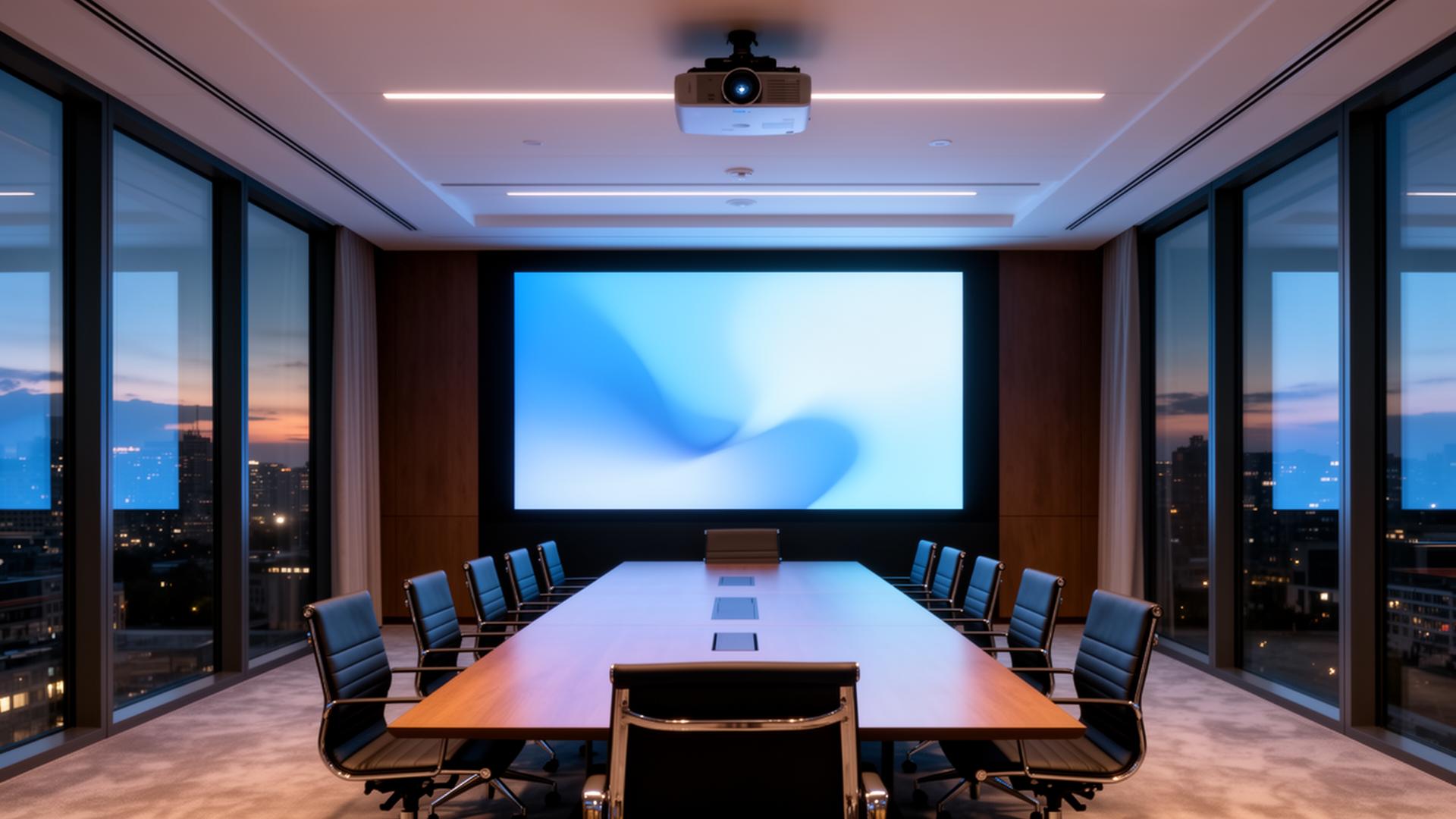
Enterprise AV for Distributed Workplaces
A single AV experience across every room, every floor, every region.
Common Challenges
Inconsistent UX across rooms
Every meeting starts with five minutes of figuring out the room.
Hybrid meeting fatigue
Remote participants visibly second-class in every call.
High service overhead
Tickets piling up because nothing is standardised or monitored.
Poor analytics on room utilisation
Decisions about space made on intuition, not data.
Fragmented vendor landscape
Different vendor per region, no consolidated reporting.
How Arif Khan Approaches It
Standardise the AV stack across the portfolio with a consistent, simple user experience, central monitoring and lifecycle governance.
Understand Environment
Deep discovery: site, threat model, operational reality, owner intent.
Design Architecture
Vendor-neutral systems architecture aligned to outcomes — not catalogues.
Integrate Systems
Engineer the program as one fabric, not a stack of independent products.
Validate Performance
Measure, calibrate, prove. Nothing is signed off until it performs.
Optimize Experience
Refine the human and operator experience over the long lifecycle.
Technology Components
Room Taxonomy
Reference room types from huddle to executive boardroom.
Reference Designs
Standardised stacks executed identically across regions.
Unified UCC Platform
Teams Rooms, Zoom Rooms or Google Meet — one strategy.
Central Monitoring
Crestron XiO, Logitech Sync, Q-SYS Reflect dashboards.
Change Management
Pilot, validate, roll out — a disciplined deployment model.
Global Governance
One vendor framework, vetted local partners, predictable rollout.
Where It Gets Applied
Common Mistakes
Designing room-by-room instead of portfolio-wide
No central monitoring or analytics
Ignoring hybrid meeting parity
Choosing vendor before defining outcomes
The terms you'll hear, explained
Specifications and proposals across security, automation and AV reuse the same vocabulary. Here are the ones that matter most — without the jargon.
A separate logical network on shared cabling — cameras, access control and BMS each get their own VLAN so traffic stays isolated and easier to secure.
Permissions are granted to roles (operator, supervisor, FM head) rather than individual users — clean, auditable, easier to revoke.
Automatic Number-Plate Recognition — reads vehicle plates at gates and barriers for whitelists, visitors and incident lookup.
An open standard that lets cameras and recorders from different brands talk to each other — protects you from single-vendor lock-in.
Open protocols used by BMS, HVAC and energy systems to exchange data — the building's nervous system.
One cable carries data and power to a camera, access reader or AP — simpler installation, fewer points of failure.
BMS runs HVAC and electrical. IBMS integrates BMS with security, fire, access, AV and energy under one operating model.
Public Address / Voice Alarm — code-compliant intelligible voice evacuation, required for crowded venues and large buildings.
Modern video compression — typically 40–60% less storage than H.264 at the same forensic quality.
Mean Time Between Failures — the right metric for picking industrial gates, barriers and infrastructure-grade equipment.
Storage redundancy — protects recordings against single-disk failure. Plan capacity after RAID overhead, not before.
Service Level Agreement — written response and resolution times that an AMC must meet. Vague SLAs aren't SLAs.
Frequently Asked Questions
Microsoft Teams or Zoom Rooms?+
Both, plus native room systems where the use case demands — Teams Rooms, Zoom Rooms, Google Meet hardware and bespoke.
Do you support global rollouts?+
Yes — standardised reference designs executed across regions with vetted local partners.
Which OEMs are typically used?+
Logitech, Poly, Cisco, Yealink, Crestron, Q-SYS and Shure, selected against the room taxonomy.
How is the estate monitored?+
Central monitoring (Crestron XiO, Logitech Sync, Q-SYS Reflect) with SLA-tracked ticketing.
Can you take over an existing estate?+
Yes — typical engagements start with an audit, a standardisation roadmap and a 12–18 month migration plan.
How is success measured?+
Meeting-start success rate, ticket volume per room per year, and utilisation against capacity.
What is the typical engagement length?+
From a 90-day standardisation sprint to a multi-year global rollout.
How do you handle change management?+
Pilot rooms, structured user testing, communications plan and floor-walker support at go-live.
For project-level planning across India, see Arif Khan's related consulting expertise:
Let's Design Intelligent Environments
A private consultation to scope your environment, the threats it faces, and the architecture that will serve it for the next decade.
Arif Khan supports project planning and advisory requirements across Delhi NCR — including Delhi, New Delhi, Gurugram, Gurgaon, Faridabad, Ghaziabad and Meerut — along with selected projects in Mumbai, Lucknow, Bengaluru and North India.