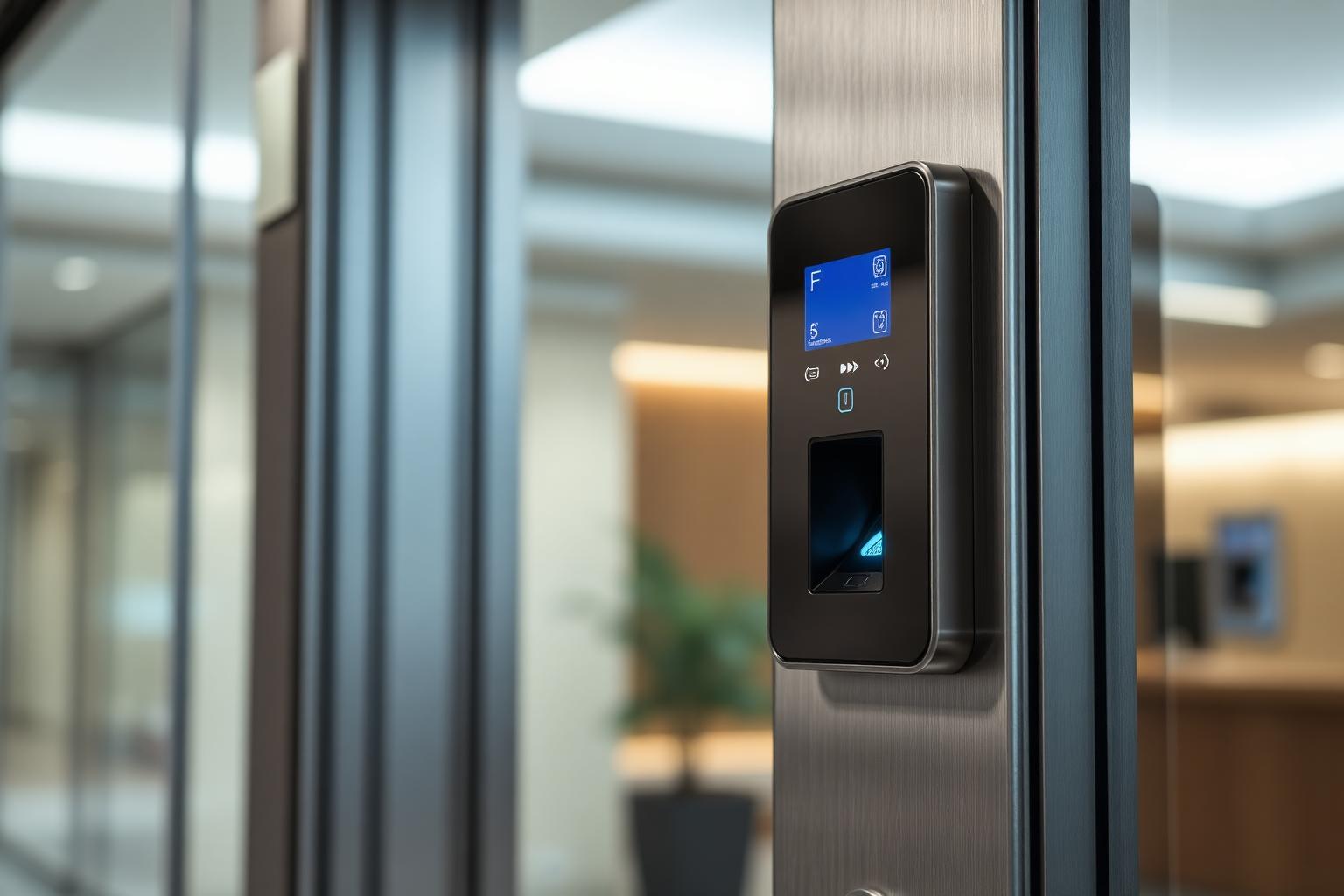
Access Control & Biometrics
Facial, fingerprint, card and mobile credentials — governed by one policy engine across every door.
Common Challenges
Per-door controllers with no policy
Each door manages its own list — no central revocation, no audit trail.
Shared cards and tail-gating
Credentials passed around and doors held open — the most common control failure.
Visitor process on paper
Reception logbooks instead of pre-registered, time-bound digital passes.
Weak integration with HR / Active Directory
Joiners and leavers not de-provisioned for days or weeks.
Biometric spoofing risk
Cheap readers fooled by photos and silicon prints.
Fire & life-safety conflicts
Doors that fail-secure when code requires fail-safe in evacuation.
How Arif Khan Approaches It
Design access as one policy engine spanning every door, lift, turnstile and parking gate. Pair anti-spoof biometrics (HID, IDEMIA, Suprema, Matrix, ZKTeco, Hanwha) with mobile credentials, deep HR integration and a visitor management workflow — code-compliant for fire egress and audit-ready for regulators.
Understand Environment
Deep discovery: site, threat model, operational reality, owner intent.
Design Architecture
Vendor-neutral systems architecture aligned to outcomes — not catalogues.
Integrate Systems
Engineer the program as one fabric, not a stack of independent products.
Validate Performance
Measure, calibrate, prove. Nothing is signed off until it performs.
Optimize Experience
Refine the human and operator experience over the long lifecycle.
Technology Components
Biometric Readers
Liveness-tested facial, fingerprint and palm-vein readers.
Card & Mobile Credentials
HID Origo, OSDP cards, Apple Wallet and Bluetooth credentials.
Policy Engine
Centralised access — Lenel S2, Honeywell Pro-Watch, Genetec Synergis, Matrix COSEC.
Visitor Management
Pre-registration, e-passes, watchlist screening and concierge UX.
HR / AD Integration
Auto-provisioning and de-provisioning from HRMS and Active Directory.
Fire & Life-Safety Interlock
Code-compliant fail-safe behaviour on alarm.
Where It Gets Applied
Common Mistakes
Per-door controllers without a central policy engine
Cheap biometrics with no liveness detection
No integration with HR for joiner / leaver flows
Ignoring fire-code egress requirements
Visitor process left as a paper logbook
The terms you'll hear, explained
Specifications and proposals across security, automation and AV reuse the same vocabulary. Here are the ones that matter most — without the jargon.
A separate logical network on shared cabling — cameras, access control and BMS each get their own VLAN so traffic stays isolated and easier to secure.
Permissions are granted to roles (operator, supervisor, FM head) rather than individual users — clean, auditable, easier to revoke.
Automatic Number-Plate Recognition — reads vehicle plates at gates and barriers for whitelists, visitors and incident lookup.
An open standard that lets cameras and recorders from different brands talk to each other — protects you from single-vendor lock-in.
Open protocols used by BMS, HVAC and energy systems to exchange data — the building's nervous system.
One cable carries data and power to a camera, access reader or AP — simpler installation, fewer points of failure.
BMS runs HVAC and electrical. IBMS integrates BMS with security, fire, access, AV and energy under one operating model.
Public Address / Voice Alarm — code-compliant intelligible voice evacuation, required for crowded venues and large buildings.
Modern video compression — typically 40–60% less storage than H.264 at the same forensic quality.
Mean Time Between Failures — the right metric for picking industrial gates, barriers and infrastructure-grade equipment.
Storage redundancy — protects recordings against single-disk failure. Plan capacity after RAID overhead, not before.
Service Level Agreement — written response and resolution times that an AMC must meet. Vague SLAs aren't SLAs.
Frequently Asked Questions
Which access control brands do you specify?+
Vendor-neutral — HID, LenelS2, Honeywell, Genetec, IDEMIA, Suprema, Matrix and ZKTeco selected against the policy, integration and lifecycle needs.
Are biometric readers spoof-proof?+
Specified readers use 3D liveness detection (IR + structured light) and are certified to iBeta PAD Level 2 where the brief requires it.
Do you support mobile credentials?+
Yes — HID Origo, Suprema mobile, Apple Wallet and Bluetooth credentials are standard on new engagements.
Can the system integrate with our HRMS / Active Directory?+
Yes — SCIM, LDAP and REST integration with SAP SuccessFactors, Workday, Darwinbox and Active Directory is routine.
Is the system DPDP Act compliant?+
Yes — biometric templates are stored as one-way hashes, with consent capture and retention policy designed in.
Do you handle parking and vehicle access?+
Yes — covered jointly with the Entrance, Gate & Parking Automation practice (ANPR, boom barriers, RFID tags).
What about lift / elevator access control?+
Yes — destination control system (DCS) integration with KONE, Otis, Schindler and Mitsubishi.
Where have you delivered access control programs in India?+
Corporate HQs, government buildings, hospitality flagships and luxury estates across Delhi NCR, Mumbai, Lucknow, Bengaluru and North India. Specific project references are shared selectively and under confidentiality.


For project-level planning across India, see Arif Khan's related consulting expertise:
Let's Design Intelligent Environments
A private consultation to scope your environment, the threats it faces, and the architecture that will serve it for the next decade.
Arif Khan supports project planning and advisory requirements across Delhi NCR — including Delhi, New Delhi, Gurugram, Gurgaon, Faridabad, Ghaziabad and Meerut — along with selected projects in Mumbai, Lucknow, Bengaluru and North India.